
Written by CFRA Member Dustin Hollinger
Can you imagine TV being a threat to college football’s existence? At one time it was thought to be true. TV has been a good friend to college football. It showcases each team’s fans and alumni that love who couldn’t otherwise see. Moreover, TV is a powerful recruiting tool, as it has built up “obscure” teams into to national brands: BYU, Boise and Central Florida. By extension, football tv stipends has extended to the colleges athletic program as a whole. In most instances, men’s basketball pays for itself and football helps fund all other athletic programs.
If you thought the 1984 Supreme Court ruling was the first TV dispute in college football, then you may be surprised it as brewing for decades before that landmark ruling. Before we explore that, let’s start with the recent actions. Last season saw 17 schools switched conferences. One reason given was “competitive balance”. That made me think: If UCLA’s last The Pac-10\12 Conference title came in 1998. How is entering a more rigorous conference competitive balance?” After attending last spring’s Gator Bowl webinar, it hit me though. At the meeting Gator Bowl President Greg McGarity emphasized “The Gator Bowl is hoping to play on January 2 but it’s up to Disney.” Then it hit me: could this so-called competitive balance be financial?
In spring 2021 college football took notice when it was announced Texas and Oklahoma will be departing from the Big 12 to the SEC. At that time, I thought that will be good for college football. This would cause the Big 12 to reach into the AAC for Oklahoma and Texas. Those fortunate to be selected by the Big 12 now will have a much easier pathway for playing for a national championship and winning The Big 12 guaranteed at “worst” a New Year’s trip to the Sugar Bowl. In turn, the AAC will offer membership to Sun Belt and CUSA schools, since the AAC Champion has gotten a NY6 bid 5 out of the last 7 years.
All is well in college football…. So I thought. Then summer 2022 it was announced UCLA and USC will be joining The Big 10. That sent shock waves though out the NCAA. At first I questioned these four moves because their pathway to a national championship will become harder. Then the motive become visible. It was the lucrative TV revenue. These conference additions brought concern and excitement. This would bring first time games: Oregon vs. Maryland (2,880 miles) Stanford vs NC st, California vs. NC st and Wake Forest vs. California.
Each of the California/ Stanford games are at least 2,300 miles apart! No longer will these schools have to wait for bowl games for these far flung match ups. The transcontinental travel is quickly became a concern. Now ACC,Big Ten and SEC get the “Hawaii” travel for road games. That prompted California’s governor to have UCLA (not USC because they’re a private school) to justify the move.
Unlike today, where the SEC and Big Ten are in the driver’s seat and the rest of Division1 feels “fortunate” enough to be a long for the ride, until the 1970’s the decision making was “evenly” distributed among all D1 conferences. That worked to the “advantage” of smaller leagues at the “expense” of larger ones. For example, The Robin Hood Plan “dispersed everything evenly among Division 1 football schools”- like The NFL. That meant the 1981 #1 USC vs.#2 Oklahoma that was shown on 200 stations would get the same TV pay out during the other broadcast: Appalachian State vs. Citadel on four stations. Each year, the major blue bloods were simply out voted. That meant TV revenue would be evenly distributed like the NFL. Up until the 1970s, the NCAA had a strong enough hold that the networks had to adhere to their game schedules. As a result, Division 2 games were regional televised. How did The NCAA get this iron fist that they ruled with that made blue blood football programs and tv networks to adhere them?
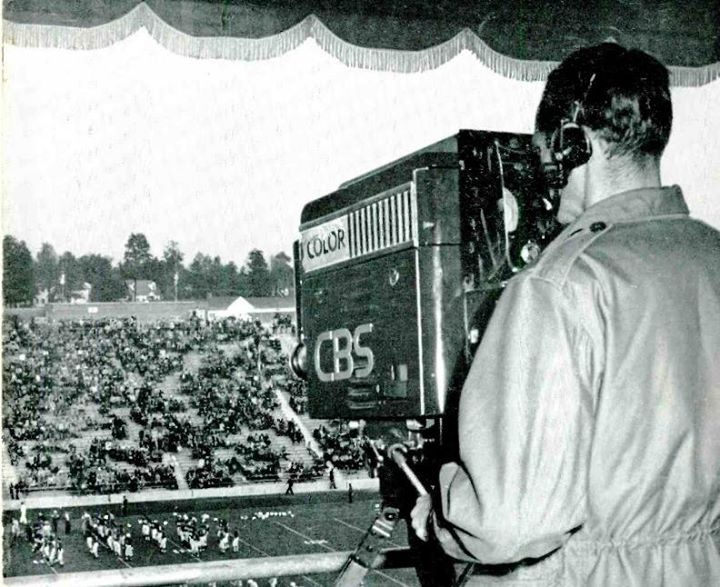
It started in 1948 when University of Pennsylvania was struggling to pay the mortgage for Franklin Field and Palestra- their basketball court. Needing revenue of $1.6 million, Pennsylvania believed televising their home games would be the solution. In 1950 University of Pennsylvania sold their rights to ABC for $150,000. Athletic Director Francis Murray believed that it could double the following year. TV and Quaker Football is nothing new. Philco televised their 1940 seven home games and according to the 1981 NCAA Television Briefing University of Pennsylvania the first TV game by Philco reaching all six Philadelphia households.
During World War II, TV games were rare and sporadic. When this became public knowledge its sparked fears that it would hurt attendance for smaller schools. This was viewed as a ploy by a (at the time) major top 25 team. As for the major programs (silly as it sounds in 2024), SEC, Big Ten and SWC (perhaps some irony and hypocrisy) felt their programs were at stake because they believed their livelihoods depended on ticket revenue. NCAA was alarmed by these reports took swift action to take over control over live tv broadcasts. As a result, Pennsylvania, Army and Notre Dame had similar deals were forced to abandon them. During the NCAA 1951 convention, the act of banning live TV games for the 1951 season was approved 161 to 7, with 45 abstaining. During that convention, the NCAA took over the television marketing schemes, thus almost assuring no broadcasts would be shown within a member Institution’ area on gameday. Perhaps it was this 1951 convention that turned the NCAA into the powerful enforcer we know, well at least recently. Due to public outcry, the NCAA somewhat compromised by permitting one game a week to be shown locally.
The University of Pennsylvania hoped this small reversal would give them some leverage. They went ahead with the ABC deal leaving it up to the NCAA to determine which Penn games (if any) would be televised. Ultimately, that notion did not suit Penn. By June 1951, they re-negotiated an extra $50,000 with the promise of splitting the TV pay with their opponents. This move was the hope that NCAA would accept this compromise. In my speculation by splitting the TV pay with their opponents would gain more support mainly, votes in next year’s meeting in their favor. NCAA responded by stating that ” University of Pennsylvania isn’t in good standing.” That came with Quaker golf, track and tennis teams wouldn’t be allowed to play in the upcoming NCAA Tournaments! With the option of expelling them during next year’s convention. That lead their opponents dropped out playing them.
Interestingly, The Rose Bowl on January1,1952 was nationally televised because the Tournament of Roses Committee who owned the Rose Bowl Game was out of the NCAA’s realm of control. Facing expulsion from first the Ivy League, then the NCAA, University of Pennsylvania filed antitrust lawsuits, but they weren’t resolved by the June 19, 1951 deadline to confirm or be removed. Pennsylvania had no choice but to comply with the NCAA. Due to major college football teams complaining about lack of tv coverage and smaller ones little or none NCAA allowed each team up to four tv games a year.
The Aftermath for Quaker Football
University of Pennsylvania found another way to get them out of financial struggle by renting Franklin Field to The Philadelphia Eagles for $100,000 a year. Franklin Field was the Eagles home from 1958 to 1970. As Ivy League officially begin in 1956 ,this seven time National Champion went from having 60,000 home attendance to the forgotten obsolete. Despite winning 17 Ivy League Championships between 1982-2016 this Division 1 program resembles a high school football atmosphere.
The following is a 1953 statement by University of Pennsylvania President Harold Stassen: “The NCAA television control program is regarded by the University of Pennsylvania as illegal and unwise; hence we have not participated in it, and we opposed it. Our opposition has been thus unsuccessful, but it’s believed in time the centralized control scheme by the NCAA will be abrogated and all universities and colleges will enjoy the same rights and freedoms as the respect they do in other matters.” That came true in 1984.
In the current climate of NIL, unlimited transfers, coaches and players gone before the bowl game. It has the colleges looking like mercenaries auctioning themselves to the highest conference bidder, and the players looking more like independent gig workers. This statement is very prophetic: “in addition to being there in the beginning, we’ve also invented everything that’s wrong with college football. From people playing in their seventh year to players paid under the table, to the tv disputes about the role of television. At one time or another. Because we’ve played played football for so long, we’ve seen everything that can go wrong. So we have a lot of experience trying to fix it. If we can stay true trying to do right, then we should matter to college football and people should continue to care about us,” Jeff Orleans Ivy League Director, in 2004.
 The College Football Researchers Association