
Army and Navy Football Have a Combined 78 Conference Championships You Never Knew Existed
by Dustin Hollinger
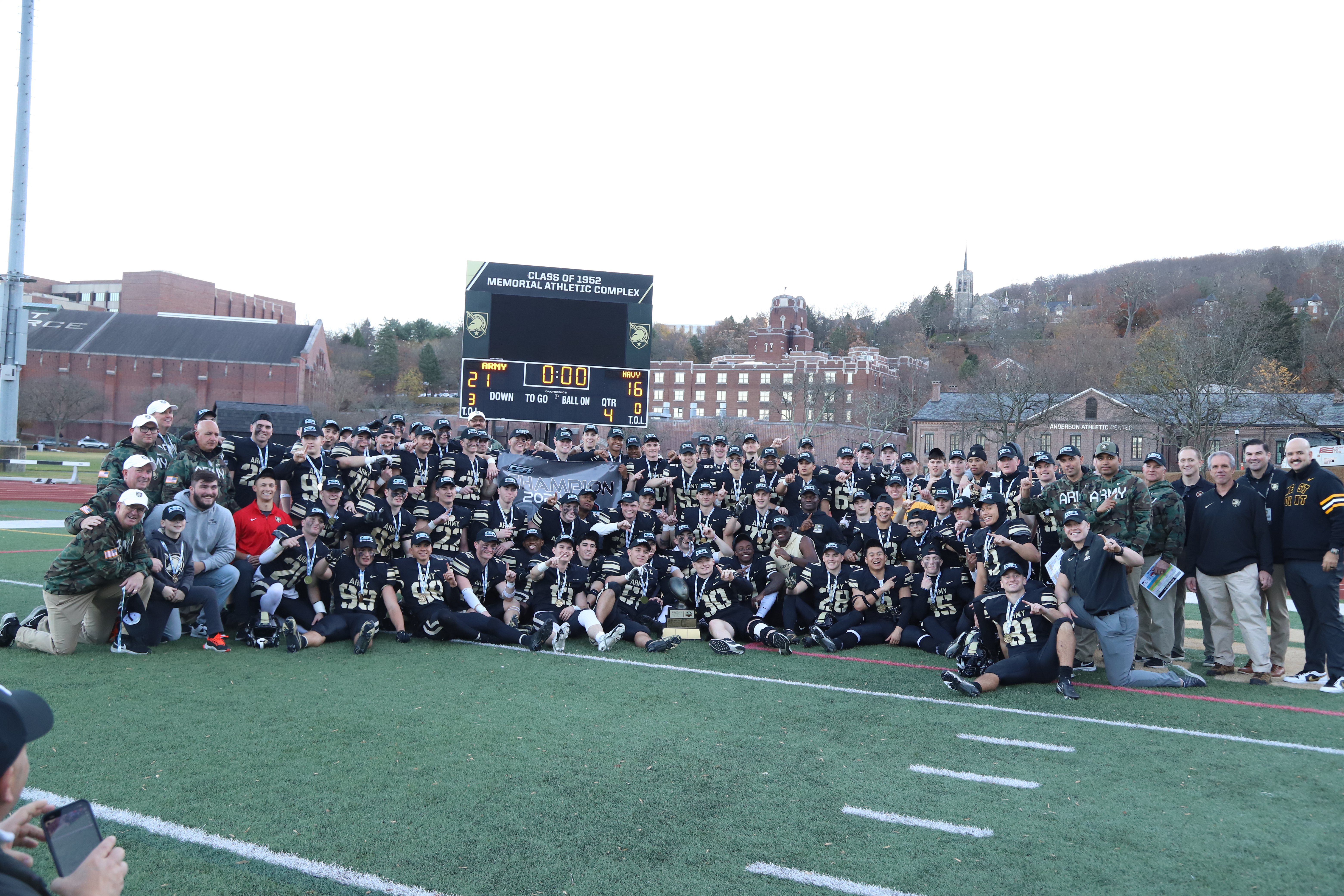
Navy Football has won 40 league championships and 38 for Army. How can that be you ask? No it’s not the loosely affiliated Lambert “Eastern Championhip” Trophy. No it can’t be that because Army has won 9 Lambert Trophies and 6 for Navy respectively. I ask again how has Navy football won 40 conference championships given they been a AAC member since 2015. How it possible for Army to win 38 conference championships if they were a C-USA member for six years and joined the AAC last year? Is this a trick question? Well sort of.
Here’s the kicker, in 1946 Navy joined what was then known as The Eastern 150 Pound Football League (now known as the Collegiate Sprint Football League) and 1957 for Army. Before we can explore Navy and Army has dominated this league we must understand the league itself. Cornell and Penn is credited for the concept of “light weight” football. By the 1930’s there was the opinion that football players were getting too large. In 1934 the average man was 5’8 and 150 lbs. Today the Collegiate Sprint League weight limit is 178 lbs. Player “weigh in” is two days before the game. Just like other contact sports like wrestling, boxing and martial arts, to be eligible players must remain in their weight limit.
Sprint Football has a 70 player roster limit, similar to the NFL active and practice squad. By having roster limits can increase the quality of play. They’re two Sprint Football Leagues: The original CSFL in New England and the upstart Midwest Sprint Football League in the South and Midwest.
The first thing you’ll hear about the CSFL is ” this is varsity, full contact Intercollegiate football.” Currently, the CSFL has 9 members that play Division 1 or 2 in other sports. This league plays a 7 game season with an option for 8 if they are not playing in the CSFL Championship Game. Over the decades membership has shifted between 3-10 teams. The majority of the time its been eight. That’s small compared to the current “super conferences” era. But that’s the average amount for the Big East, Mountain West, WAC, Sun Belt and ACC during the 2000’s.
Current CSFL teams are: Army, Navy, Chestnut Hill, Cornell, Caldwell, Mansfield, Molley, St.Thomas Aquinas and Penn. ESPN+ is the CSFL main broadcast partner and the teams will broadcast on their athletic website or on YouTube. This is a non scholarship conference. That means the players play because they truly love the game and don’t have to “stick it out” because of the scholarship. Sprint Football is outside of NCAA realm and there’s no transfer portal.
This is one of the purest forms of college football and they place high priority on academics. Nearly all college athletic programs will say this, during the early 2000’s Cornell’s CSFL teams averaged two future doctors a year.
Famous CSFL alumni include: President Jimmy Cater, Secretary of Defense Donald Rumsfeld, rapper & actor Hoodie Allen, New England Patriots owner Robert Kraft and Delaware Attorney General Beau Biden.
Colleges that have a “conventional” football program will refer “average/smaller” sized players to the sprint team. This brand of football is predicated on speed. Since nearly all the players are the same size, it’s not uncommon to see a nose tackle run 20 yards down field to tackle a running back. For example, a few years ago in mid season , a dozen players on
Cornell’s traditional team were send over to the sprint team so they could finish out their season. At the conclusion of Army’s 2016 CSFL season , Kicker John Abercrombie started the final four games for their traditional team and remained their starter until the end of the 2019 season. On the flip side, Army once had a Corner Back that left their conventional team to his senior year to join the sprint team.
It’s normal to see a quarter back switched to wide receiver, a defensive end to tight end a running back to corner back, or a safety to wide receiver. Sprint football takes it to an unheard of level. For example, current Mansfield offensive guard Kobe Pena was a standout high school running back. Sprint football isn’t only for “undersized” football players but has been popular among wrestlers and power lifters.
For decades the regular season decided the CSFL champion. That changed in 2017 when the CSFL switched to north and south divisions and added a conference championship game. In 2022 sprint football had it’s largest expansion in its 91 year history when former Cornell President Nancy Buckel become Fontbonne University president and helped to create the Midwest Sprint Football League. This was sprint football’s first expansion west since University of Michigan in the 1940’s. Current MSFL teams are: Bellarmine University, Calmer College of St. Joseph, Midway University, Oakland City University(NAIA), Quincy University and St. Mary of the Woods College. The MSFL has a 4 team playoff. I’d love to see a CSFL-MSFL National Championship Game. For info, broadcasts and schedules go to Midwestsprintfootball.com and Sprintfootball.com
One dreary low can after the 2016 season when 10 time champion Princeton dropped their Sprint Football program after 17 consecutive years without a win!
In the CSFL you can out spend, out NIL or out scholarship anyone. I asked Army West Point Assistant Athletics Director Alex Funderburke how does Army and Navy dominate this league? He said “I would say Army and Navy alike attract certain type of people who are athletic enough for all the military aspects of the academy and that lends itself pretty well to sprint football. A lot of schools we play against aren’t well known on a national level. Where as everyone knows West Point. If you’re a high school kid and have the chance to go to West Point and play for the sprint football team, I think it’s a no – brainer. That’s the reason why I feel the program has been so successful.”
Perhaps a major factor is the rigours training the academy students receive that sets them far (emphasis on far) apart from the rest of the CSFL. Army and Navy have their challenges such as the five year armed force commitment upon graduation and their student -athletes are barred from NIL engagements.
We’ve witnessed blue bloods fall and struggle to return to relevance. During the 90’s Oklahoma experienced it, then in the 00’s it was Alabama’s turn. At the moment Nebraska and Florida and FSU are in that unpleasant situation. But Army and Navy CSFL teams haven’t experienced it. Navy started playing sprint football in 1946 and only had four losing seasons! Army started in 1957 and only have three!
Comparing them to the Ivy League which started in 1956 , Dartmouth leads with 21 Ivy Championships, it took Ohio St 114 years to reach 40 conference titles and Alabama has 34 conference titles in 100 years. Based on the stats each Army and Navy graduating class will win two CSFL Championships. Since Navy first CSFL season in 1946 , only in six occasions a service academy didn’t win a lest a share of the CSFL Championship! Many of Army/Navy games aren’t competitive. Its not unusual to see 63-7 and 70-0 scores. Its amazing how football changes around Navy/Army but they just reload, press play and win a league title, then rewind and start over again. Many have said the SEC is top heavy. Navy and Army takes this way beyond that statement. This feels like the CSFL is a two team conference and the rest of the league are there to “fill out” the schedule. So how do they do it? From 1988-1990 Army Coach Mark West was the Army sprint football QB. During his playing days he helped the Black Knights to two CSFL Championships and a 17-1-1 record. As the coach he won 5 CSFL Championships in his 15 seasons. From 2012-2015 Navy coach Carter Reading played Comer Back lead the Midshipmen to undefeated 2014 CSFL Championship and 24-4 record. Back to the prior question how do these two programs win year in and out the past several decades? To find the answer I asked Coaches West and Reading the following questions:
(1) How has Navy and Army remained consistent champions and not falling on hard times like Nebraska, Alabama, Florida, and FSU?
Coach West ” I won’t speak on behalf of Navy. For Army, I believe we’ve avoided falling on hard times because we consistently have a large pool of talent to choose from each year. Every summer, approximately 60-80 incoming new cadets try out for Sprint Football. Most of them have multiple years of high school football playing experience. They were either too small to play Division 1 football or they really wanted to come to West Point and football was secondary to them. Either way, Sprint Football is able to select from a large group of walk-ons each year. Navy Coach Reading:” I believe it comes down to grit and culture. From day one, plebes at Navy are expected to compete and win. They endure a rigours summer of team building and military indoctrination that forges a strong bond. That bond deepens as they become a part of the Navy Sprint Football family. Winning breeds winning, and the culture is relentless. These athletes come here to serve their country- not chase professional football careers. For them playing sprint football is about one more chance to compete with their brothers and who share the same passion and commitment.”
(2) Correct me if I’m wrong but doesn’t Army and Navy every year have 90 tryout for the 70 team roster?
Coach West: “Army typically has 60-80 try out each summer”. Coach Reading:” We typically start with 130 players and that number gradually narrows down. Usually we begin the season with around 95 players suited up in pads.”
(3) Army and Navy consistently blow out opponents by 70-0 and 63-7 scores It’s to the point the CSFL feels like a 2 team league and the rest are there to “fill out” the schedule. How is Army/Navy talent so far ahead of The CSFL?
Army Coach West said “First of all, not every game is a blowout. With that being said, Army and Navy typically find themselves in the championship game every year. There are probably many factors as to why this is, with the talent being the least of them because ever team has talent. Every team has good coaching, so it’s hard to say that is the reason why we win as often as we do. I believe the main factor is we’re always able to fill out our 70 man roster with quality athletes across all positions. This means typically we more depth because the try out pool we choose from every summer (see question 1). This depth really comes into play at the offensive and defensive line positions. I am selecting players at tryouts who have played offensive or defensive line in high school ,so they are already familiar with those positions. Other schools may not have the pool of linemen to select , so they are having to convert players who play other positions to offensive or defensive linemen (don’t get me wrong, we do that occasionally as well). I am a big believer that the game of football is won in the trenches, so having quality depth at those positions are huge. Another factor that helps Army is we have a Division 1 program, and occasionally we will get players from that team because they were either cut or they realized they would never play D1. Only Navy, Penn and Cornell have D1 programs.” Coach Reading: “I believe it comes down to player-led culture and the intense commitment each athlete brings. At Navy, the team is made up of recent graduates who volunteer their time between training cycles and play with a deep sense of purpose and pride. This leadership , combined with the guidance of our coaches , drives a culture of accountability and high standards that are hard to match. Another key factor is the mental and physical toughness developed during what we call “fourth quarters”. These grueling periods occur at the beginning of fall try outs and before spring break during the spring. They are some of the toughest weeks of the year, pushing players to their limits and forging unbreakable bonds. Many players say they leave the academy not necessarily remembering every play of score, but vividly recalling the challenges and camaraderie experienced during experienced during four quarters. This shared adversity builds a resilient team that’s not just talented, but deeply connected relentless in pursuit of excellence. This combination of culture, leadership, and the unique grind of fourth quarters is what sets Army and Navy apart from the rest of the CSFL.”
(4) Other than the different offense, has Army/ Navy winning methods changed since your playing days?
Coach West said ” Besides the different offense, the biggest change since my playing days is that sprint football is a year -round sport. The team has a regimented strength and conditioning program. When I played, having a year-round off-season program was probably not need like today. I assume that that all of our opponents have strength and conditioning program as well. By having a regimented program, the team remains committed the entire year. They bond with each other even more during my playing days. At a school like the Military Academy, team bonding can be pretty powerful because everyone is going through the same hardships together”. Coach Reading: “Not at all, if anything, the culture has only grown stronger and raised the bar even higher. The core principles ebb and flow with each team, but it always comes back to hard work and embracing every opportunity to compete and improve.”
(5) Doesn’t the CSFL prohibit off campus recruiting? If so, do the academies seek out well- conditioned student- athletes and encourage them to apply to the academy with the objective of joining the team?
Coach West ” You’re correct League rules prohibit off campus recruiting. The majority of my recruiting is done though word of mouth. I have a great aluminum base who serve as my “birddogs” so to speak. If they come across a young man in or in their hometown, and believe he may be able to play sprint football and be a good cadet, they will contact me and let me know, and I’ll take it from there. We have social media outlets that may help with recruiting to some degree, but I’m often amazed at the number of emails I get out of the blue from a young man who tells me he has always wanted to attend West Point and happen to hear about sprint football. I also have a number of coaches around the country who have provided me with players though out the years and we have established relationships. They contact me if they have anyone who has what it takes to the Academy and play sprint football.” Coach Reading: “The academies are unique in every student “pays” tuition through military service, and and are held to high physical standards from day one. This means we start with a pool of wells conditioned athletes who are expected to participate in sports. Sprint football is a natural fit many, and because the pool is so large and motivated, formal recruiting isn’t necessary.”
(6) Starting in 2017 The CSFL has staged a championship game. Every year since 2018 Army and Navy played in this game. This championship game provides another chance to play Star Series (Sprint footballs rendition of “America’s Game” both team emblems have a star) against your chief rival. This game has costed Army a CSFL Championship in 2018 and 2023. For Navy it’s costed them the 2019 and 2024 championship. Is the CSFL Championship Game worth it? Would it be better to have a split championship or a definitive one?
Coach West ” Having the opportunity to play Navy twice is definitely worth it, even if it means you lose a championship. As a college athlete, you want to compete against the best. The Army -Navy match up allows that, not to mention it is one of the fiercest rivalries in all of college sports.” Coach Reading: “The CSFL reverted in 2025 to the previous format. Our goal remains unchanged: dominate every game, beat Army, and win the championship. Having a definitive championship game adds clarity and stakes to the season, which benefits the league and our players.”
(7) To What extent has the partnership with ESPN+ benefited the CSFL? Why hasn’t the exposure brought more visibility?
Coach Reading:” Honestly, I’m not sure the partnership has expanded visibility significantly. Having to pay to watch the games can deter some alumni and fans. The men who play in this league do so for the love of the game, not for publicity. ESPN+ offers a vast library of content, so unless the viewers specifically seek out CSFL games ,they can be easy to miss. In that sense, the audience watching is largely those who are truly invested.”
(8) Football’s safety is a major concern. Many kids are using lacrosse as a substitute. Sprint football weight limits can make the sport safer. Why hasn’t this brand of football hasn’t been more utilized by colleges, middle and high schools?
Coach Reading:”Sprint football can be indeed safer- but injuries still occur from big hits to the strain of weigh management. Affordability is likely a key barrier. Many schools underestimate the costs of running a football program- to the costs of travel, coaching and training- that could easily surpass $200,000 annually. Sprint football resembles the style of football we played up to high school, similar to Pop Warner leagues. For high schools this could be too niche or polarizing, the best athletes tend to gravitate towards traditional varsity football.”
(9) Given the service academies 78 league championships in 80 years. Why hasn’t more people taken notice of this unprecedented, unmatched achievement?
Army Coach West ” That’s a good question. Occasionally a nationally syndicated media outlet will do some type of special on Army – Navy sprint football rivalry. I think the last time may have been in 2013 when ESPN ran a special on its Game Day. More of our games are on ESPN Plus now, so hopefully this will bring the league more recognition. Notice I said league. I want the CSFL to thrive. If not ,then it doesn’t matter what Army and Navy do, because there will be no league for them to do it. Now that there’s a Midwest Sprint Football League, my hope is to have a true National Championship Game between The CSFL and MSFL Champions.” Coach Reading: “That largely comes down to publicly and resources. Sprint football isn’t sponsored heavily, and there isn’t a lot of money behind it. I’m not sure if that will change soon, but we play for the love of the game and the brothers beside us. There’s a powerful legacy in Navy Sprint football, and its our responsibility to uphold it with pride”.
Final Assessment
As Coach Reading mentioned the CSFL will eliminate the title game. That gives more opportunities for the service academies to share the CSFL championship as they done so 7 times.By eliminating the North & south divisions ,if Army and/or Navy were to slip up any of the seven other teams would be more than happy to share the championship with them. As for the 6 MSFL members they have a 4 team playoff. That can make an exciting upcoming season for both conferences.
It was a highlight to gain insight into these two programs dynasty. Both coaches have similar experiences but with different perspectives. Both where college players that won league championships but in different eras and on opposite ends of the field. Mark West was Army’s Quarter Back during the late 80’s into the start of the 90’s. This in a era when the game was more physical and the main offense was the I- Form,Wishbone and Pro Set. As for Coach Reading , he played Corner Back during the 2010’s in the modern era when defenders are coached not to use their head as a weapon, an emphasis on player safety and nearly all teams are using the Shot Gun offense.Maybe the The service academies could’ve have won their CSFL titles without these two players. If you assume a player- alumnus will automatically win a championship since their program has decades long of success, Scott Frost says hello.
Coach West and I agree that a sprint football national championship game between the MSFL and CSFL would be a outstanding idea. In my opinion the CSFL might want to use their partnership with ESPN. Since the service academies are the only ones that field major college football teams, they may need to use their AAC TV and Bowl game payouts to fund this potential national championship game.
Coach Reading hit on something. If sprint football is similar to Pop Warner leagues ,then by the time they get to high school or college it will be ordinary and won’t be viewed as an “inferior” or “novelty “. Schools can make the game safer by adding Sprint football. This can be accomplished by eliminating varsity,JV with TWO varsity teams: Heavy and Light Weight teams. As NCAA considers roster limits , adding sprint football could be a solution. The recent ongoing changes that are occurring in major college football have made many feel that college football is losing its charm, pageantry and heritage. Some have gone to the point of giving up on college football altogether. If this is you, then sprint football might be your solution. In most cases the fan won’t exchange sprint football for their favorite team. Still, why not check out the CSFL and MSFL during pre, halftime and post game. You might find a new team you enjoy following. As a reminder,games are broadcasting live on YouTube and each teams athletic web sites. For info at Midwestsprintfootball.com and sprintfootball.com.
Granted, this is small time college football and that tends to get less attention. Still people have taken notice of Division 3 Linfield’s ” the steak ” that started 1956 and haven’t a losing season since. Mt. Union or St. John’s dynasty or the “Biggest Little Game” between Amherst and Williams.
So the million dollar question is why haven’t more taken notice of Army and Navy (or if you prefer Navy- Army) Sprint football unmatched , unmatched dominance?
“We play the game because we love it. We loved the game beyond the prize”- Four time All American Truxtun Hare in 1900 over the increaing “professionalism” in college football. Fascinating that 125 years later the same concern and same passion for college football remains.
 The College Football Researchers Association