By Dustin Hollinger
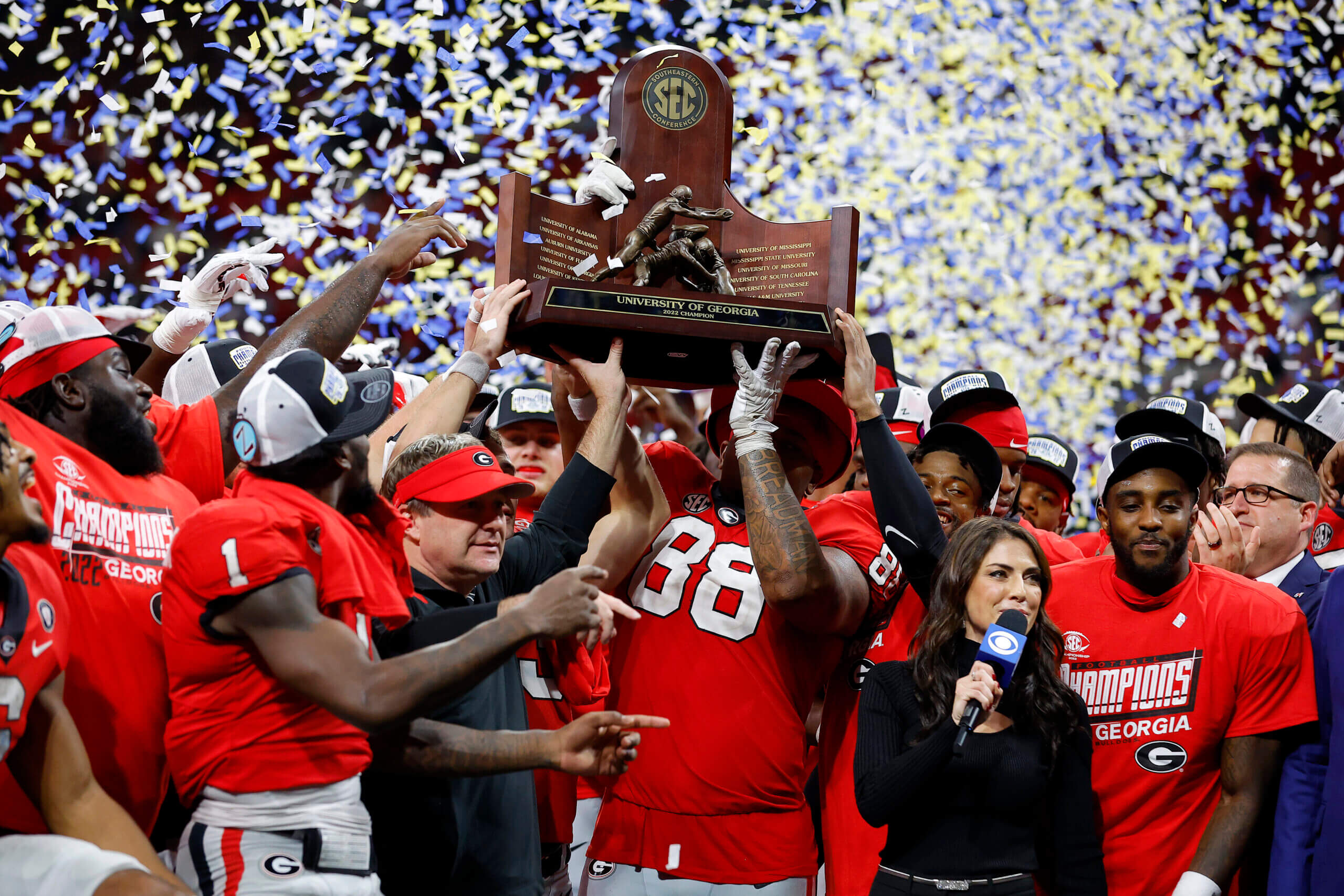
The Division I Conference Championship Game was the brainchild of then-SEC Commissioner Roy Kramer in 1992, who found a loophole that had been instituted for Divisions II and III. That clause stated that if a conference had twelve members and two divisions, then a conference championship game would be permitted.
At first, coaches and administrators hated this novel idea because they didn’t want college football to have a playoff. Alabama coach Gene Stallings didn’t want to risk his 11-0 team’s chances at a national championship. As more conferences added their own championship games, they brought excellent matchups and a few mismatches. It was a fun “appetizer” before bowl season.
When the Big 12 added its own game, Nebraska coach Tom Osborne was opposed. He said, “This game will cost a team a national championship.” That prediction turned out to apply to his own team when Nebraska lost the first Big 12 Championship Game, likely costing them a Bowl Alliance National Championship Game appearance. By the end of the 1990s, “mid-majors” like the MAC and WAC were enjoying the national exposure that came with being among the few conferences with championship games.
I’m certain that in 2002, Ohio State and Iowa, both going 8-0 in the Big Ten, would’ve loved to have had a conference title game. Then there was the 1995 “WAC-y WAC” (yes, that’s a bad pun, and yes, I know I’m no Gene Shalit), when four teams shared the WAC crown. Would a 1989 Big Ten Championship Game have helped determine which of the four co-champions should’ve gone to the Rose Bowl? Finally, there was the 2004 Big East (now the American Conference), where four of the seven members shared the league championship.
While the Pac-12, ACC, Big Ten, SEC, and Big 12 battled for the Sugar, Rose, Fiesta, and Orange Bowls — or a direct national title shot — the MAC, Conference USA, Sun Belt, SWAC, Mountain West, and WAC gained much-needed national TV exposure with hopes of landing one of those once-prestigious BCS/New Year’s Six bowl bids. Conference Championship Games made college football better, especially in 2017 when the Big 12 title game featured its two best teams. Soon, all but the SWAC and Sun Belt adopted this improvement.
Every year, I looked forward to Conference Championship Weekend. Last year, the Big Ten title game featured #1 Ohio State (12-0) and #2 Indiana (12-0), while the ACC Championship featured #20 Virginia (10-2) and Duke (7-5).
Last December, I started to reappraise Conference Championship Games — not because of the ongoing CFP modifications, but because of how Duke (7-5) could play in the ACC Championship over #22 Georgia Tech (9-3), Pittsburgh (8-4), SMU (8-4), and #9 Miami, Florida (10-2). (Rankings reflect the NCAA-approved Top 25.)
Then I remembered that two years ago, the Big 12 had four teams tied for first. That year, the Alamo Bowl helped by pairing Colorado and BYU, two teams left out of the Big 12 title game. It happened again last year, as four teams from the SEC and Mountain West ended up tied at the top, while the American Conference had three co-champions. Meanwhile, Alabama State (10-2) was the odd team out in the SWAC and didn’t receive an official NCAA Division I Playoff invitation.
Unless it’s Notre Dame, wouldn’t Texas, Navy, Alabama State, New Mexico, and San Diego State have loved to share their league championship, even if they weren’t included in the CFP? Duke can probably attest to that.
Furthermore, during the last two years of the 12-team CFP, several one-loss teams — such as Oregon, Mississippi, Ohio State, Indiana, and Texas A&M — had outstanding seasons with nothing to show for it at the end.
The CFP is expected to expand, and that has led many to call for the end of conference championship games. I now agree. Soon, the CFP will include every “high-major” 9-3 team just as bowl games once included all 6-6 teams. That makes winning a conference championship more valuable and prevents college football from following college basketball in turning the regular season into a three-month glorified scrimmage.
As soon as the TV contracts expire, I believe there’s a strong chance the “Power Four” conferences will eliminate these games. I’d like to see the “Group Six” do the same. I think there’s almost zero chance of that happening because they’ll be fighting for the one CFP table scrap that grandiose Greg Sankey and tone-deaf Tony Petitti toss onto the floor.
That means if conference championship games are eliminated, it’s possible for nine teams from the Big Ten and SEC — and eight from the ACC and Big 12 — to claim conference championships. Yes, that would be excessive, but it’s also extremely unlikely.
I say if multiple horses cross the finish line simultaneously, then they should share the cup. That’s far better than a college football playoff participation ribbon.